


There are no products to list in this category.
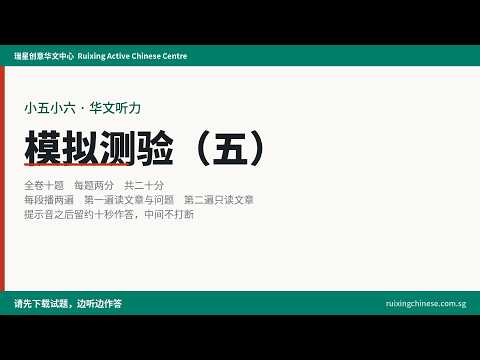
Five mock Chinese listening papers written by our own teachers at Ruixing Active Chinese Centre. The audio is free to play on YouTube; the papers and answers are free to download. Ten questions and twenty marks per paper, covering picture choice, sequencing, notices, predicting how a conversation ends, and the moral of a story. Every passage is played twice — first with the questions, then the passage alone — with about ten seconds to answer after the beep, the same rhythm as the exam.
The five papers cover ground shared by P5 and P6. These are practice papers, not past-year exam papers; for exam arrangements, go by your school and the Singapore Examinations and Assessment Board (SEAB).
Download the 5 papers and answers — free →
A new listening paper is added every week — subscribe to the playlist so you do not miss one. Secondary-level listening papers are in production and will be added to this page.
That last step is the one worth the time. Missing the words is a listening problem; hearing them and still choosing wrongly is a reading-the-question problem — and the two need completely different practice. What makes listening hard is not vocabulary, it is pace: there is no rewinding in the exam hall. Playing a paper straight through is how you find out where your child starts to panic.
PSLE Chinese includes a listening component for every candidate, whether they take Chinese or Higher Chinese — it is part of the mark, not an option. One point parents often ask about: at primary level, a Higher Chinese pupil's oral and listening are the same paper, not two separate sittings, and they are marked to the same standard as Chinese. Secondary level is arranged differently — see Higher Chinese.
This describes the general arrangement for 2026. MOE and SEAB rules can change from year to year, so go by your school's and SEAB's notices for the current year.
Is P5 too early to start?
No. These papers cover ground shared by P5 and P6. A P5 child who starts now will have a trained ear by next year.
Will my child see the answers first?
The answers and explanations are a separate file, so you can hold it back. Let your child finish a whole paper and mark it first.
What comes after these five?
Keep listening with our free story videos, or read along with current affairs on the news page. Listening improves with steady exposure, not last-minute cramming.
Ruixing Active Chinese Centre is in Bugis and has been teaching since 2012. In-centre group classes are capped at 6 pupils, online groups at 20, and one-to-one is available at every level. Group trial lessons are free; a one-to-one trial is S$30 for two hours.
There are no products to list in this category.

